8.1 The Surface Is the Inside
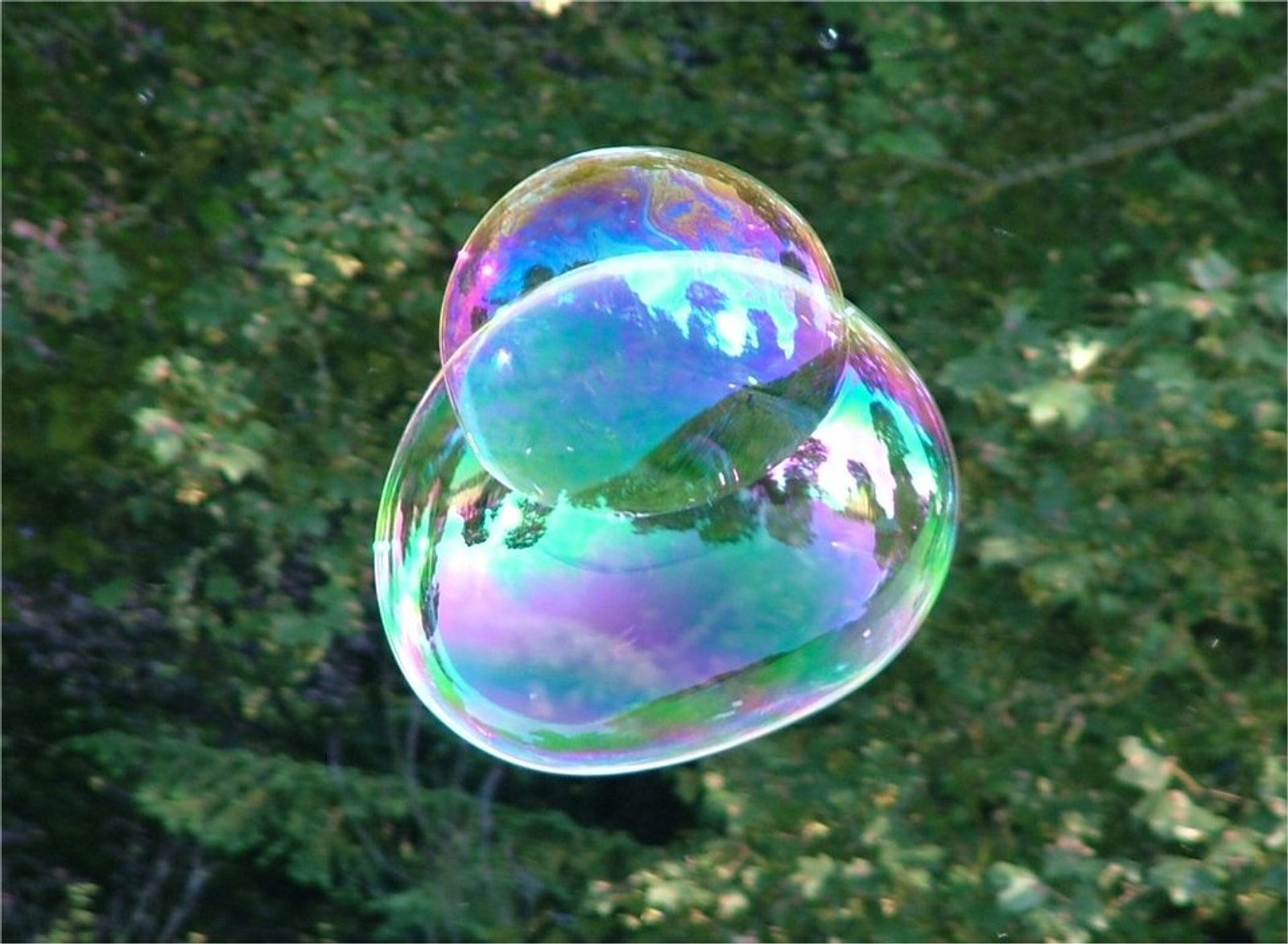
A soap bubble is pure surface with nothing inside it but air, and yet it is entirely complete, which is the holographic principle in miniature: all the information in a volume lives on its boundary, and depth is just surface you haven’t turned over yet.
The Bubble
Surface
A child stops everything for a soap bubble. There’s something revelatory about it, not just beautiful. As if it’s showing us something we already knew. It is.
Depth
A soap bubble is pure surface. There is nothing inside it but air, the same air that’s outside. No hidden interior, no depth to excavate. And yet a child stops for it. Not only because it’s pretty. Because it’s showing her something: a thing that is entirely boundary, entirely edge, and entirely complete. The soap bubble is not a metaphor for this insight. It is an instance of it (see The Soap Bubble as Recognition, Not Metaphor).
The Mandelbrot set’s[mandelbrot] complexity lives not in its interior, which is uniform, shapeless, dull, but on its boundary (see The Edge Is Where Everything Happens). Zoom into the edge and you find more edge, forever. The interior is simple. The boundary is where everything happens. The bubble is all boundary. So, it turns out, is everything else that matters.
When you dig into the depth of something and expose it to explore it, it becomes surface. Peel back the skin of a cell and the molecular machinery underneath is now what you’re looking at, it’s the new surface. Crack open that machinery and the protein folding is the new surface. There is always another layer, not because depth is infinite but because surface is what experience does with whatever it touches. Depth is surface you haven’t turned over yet.
Physics arrived at the same insight from a completely different direction. The holographic principle, grounded in Bekenstein’s[bekenstein] entropy-area law and developed through Hawking’s[hawking] work on black hole thermodynamics, shows that all the information in a volume of space is encoded on its boundary. The interior is a projection of the surface. This is not metaphor. It is physics. We used to think the cell membrane was featureless wrapping. Now we know it intermediates an enormous variety of communication mechanisms, recognizing requests, broadcasting state, mediating the cell’s relationship with everything outside it (see The Cell That Makes Itself). The membrane is not packaging. It is the cell’s principal organ of expression.[thompson]
The Sufis knew something about boundaries. In Ibn Arabi’s metaphysics, the barzakh is the isthmus, the intermediate realm that separates and connects different states of existence.[ibnarabi] Not a wall between inside and outside but a mediating realm of its own, where the invisible becomes visible, where interiority expresses itself outward. The holographic principle in the language of physics. The bubble in the language of mysticism.
Physically, there are three things: interior, exterior, and the surface that is their boundary. Everything this pod has discussed so far is about that surface, the exterior boundary. Whitehead[whitehead] showed that everything has an experiential inside, an interiority that is not spatial but felt (see Everything Has an Inside). But “inside” now means something different from the air inside a bubble. It means what the bubble is from within. And if this experiential interiority is real, what kind of boundary could it have?
Not a surface. The boundary of an experiential inside is communication. When one interiority makes itself available to another, encoding, transmitting, decoding across a shared medium, that act of making-available is the boundary itself. Not something that happens at a boundary, but the boundary between two interiorities. A dolphin’s call, a cell’s signaling, a galaxy’s exchange of light, a human conversation, each is a boundary between insides. The exterior boundary is the barzakh between a thing and its world. The interior boundary is the barzakh between one interiority and another.
And unlike the exterior boundary, this one is not a surface at all. It is structured, layered, and, as it turns out, fractal — developed in The Boundary Is a Stack.
The bubble holds the question open. It has no spatial inside at all. And yet it is entirely complete. This is something to meditate on. Not to measure.
Script
A child’s face. A soap bubble drifting past. She’s not thinking about physics. But her stillness is recognition.
A black hole boundary, same geometry. Different scale.
Images
Soap bubble catching light Black hole accretion disk Cell membrane electron microscopy