2.7 The Cell That Makes Itself
The cell’s molecules are replaced every few hours and yet the cell persists, because what defines it is not its material but the circular process, components producing the network that produces the components, that figured out, three billion years ago, how not to stop.
Life is defined not by what it’s made of, but by the circular process that keeps making it.
Surface
Here’s a question that sounds simple: what makes something alive?
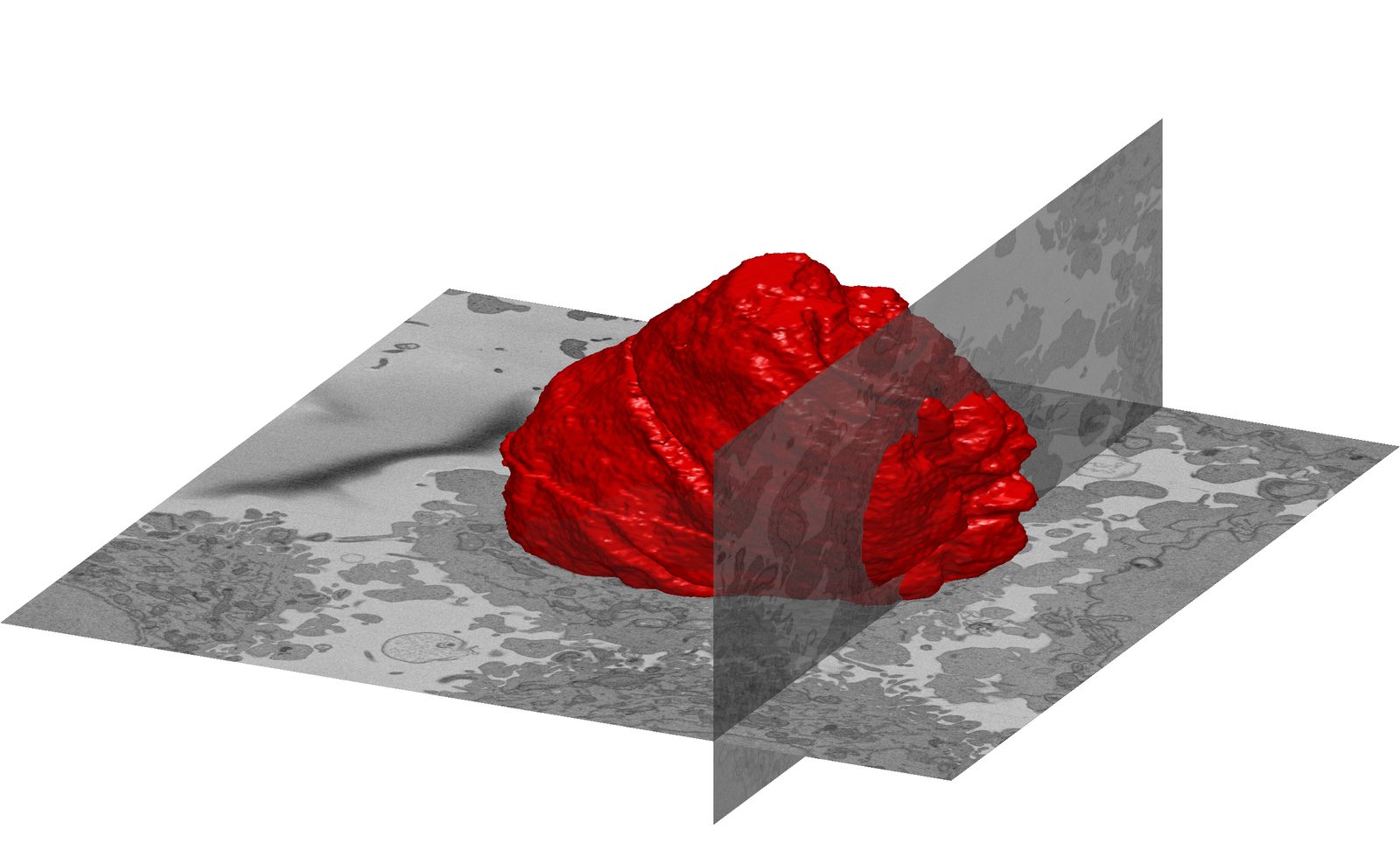
You might say: it grows. It moves. It responds to things. It reproduces. All true. But those are behaviors. They describe what life does. They don’t say what life is.
Try this instead. Imagine a single cell, the simplest living thing you can find, a bacterium smaller than anything you’ll ever see with your naked eye. Every few minutes, its molecules get replaced. The proteins that were there a moment ago are gone. New ones have been assembled in their place. The actual physical stuff of the cell is constantly turning over. In a matter of hours, almost nothing that was there before is still there.
And yet the cell persists. It has the same shape, the same behavior, the same boundary. It’s still recognizably that cell.
How?
The answer is strange and beautiful. The cell makes itself. Not only once at birth. Continuously, right now. The proteins inside the cell are produced by processes inside the cell, using components made by processes inside the cell, wrapped in a membrane produced by the cell, which keeps the inside inside so those processes can continue. It’s a circle. Not a closed, static circle. A living, self-sustaining one.
Take any piece away and the circle breaks. Add the right pieces back, in the right arrangement, and the circle resumes. What you’re looking at is a process that keeps reconstituting the very thing that makes the process possible.
And the interior of that bacterium, too small to see, smaller than a wavelength of light, is not quiet. It is a storm. Thousands of molecular machines, each one a protein folded into a precise shape, grabbing passing molecules, transforming them, releasing them, all of it happening millions of times per second, in a space you could fit ten thousand of inside the period at the end of this sentence. The circle holds not despite that chaos but through it.
Two biologists, Humberto Maturana and Francisco Varela, gave this a name in the 1970s: autopoiesis. From the Greek: auto, self; poiesis, making. A self-making system.
Here’s why this matters. The universe is not on the cell’s side. Heat disperses. Molecules drift. Radiation breaks chemical bonds. Entropy, the tendency of everything to fall apart, spread out, and go inert, is relentless. The cell holds its shape against all of that, not by being rigid, but by continuously remaking itself faster than it dissolves. That loop, stable enough to persist against everything trying to disrupt it, flexible enough to respond when conditions shift: that is what evolution found. Structure Is What Randomness Does shows how structure emerges from random process; a self-maintaining loop is one of the structures that emerged.
And notice what it means to be defined by your own self-production. The cell doesn’t just happen to be organized this way. That circular organization is what the cell is. It acts, selectively, differentially, in ways that sustain the circle. That selectivity is the first faint trace of what Everything Has an Inside is about: the idea that having an inside is not a luxury of brains. The cell has an inside in a precise, non-metaphorical sense. It has a boundary it maintains. It has a process it sustains. Things that help that process are, for the cell, different from things that don’t.
Depth
Most definitions of life are lists of behaviors: metabolism, reproduction, response to stimuli. Humberto Maturana and Francisco Varela’s[maturana] definition is structural. For a more accessible treatment that develops the cognitive implications, see [maturana-2]. In their 1972 paper coining the term autopoiesis, they asked: what organization is necessary and sufficient for a system to be living? Their answer: a network of processes that produces the very components that constitute and maintain the network. Remove the organization and you have chemistry. Keep it and you have life.
This is the only definition that identifies what must be true of the organization of a system, independent of what it is made of. Carbon is not required. The loop is.
As far as we know, the loop has closed only once, in the chemistry of life on Earth. Protocells in origin-of-life research approach the boundary, and viruses have been proposed, but viruses hijack another cell’s machinery to reproduce and don’t maintain their own boundary. Maturana himself resisted extending the concept to social systems, ecosystems, or machines. The cell remains the sole confirmed instance.
Whitehead[whitehead] arrived at a related insight from a completely different direction.
In his process philosophy, the fundamental units of reality are events rather than things (Reality Is Events, Not Things), occasions that arise, integrate what came before, and perish into the next occasion. A living cell, in Whiteheadian terms, is a society of such occasions organized with enough coherence and closure to constitute a persistent center of activity. The autopoietic loop is what that coherence looks like in biology.
The connection to Everything Has an Inside runs deeper still. For Whitehead, every actual occasion has an inside. Autopoiesis gives us the first clear structural candidate for what having an inside means at the biological level. The cell’s boundary is not merely physical but the boundary between what the process takes in and transforms and what it does not. That selective engagement (this matters, that doesn’t) is the minimum version of what, at greater scales of complexity, becomes feeling, perception, and eventually thought.
Nothing was added to produce this (More Is Different). The loop did not require a new ingredient, only accumulation crossing a threshold. But once closed, everything changes character. A linear system gives you proportional returns: more input, more output, until it runs dry. A closed loop is a different regime entirely. Think of a microphone too close to its speaker: the room is quiet, then suddenly the sound is feeding back into itself and the noise is unbearable, and nothing entered the room except the moment of closure. An autopoietic system acts to replenish its own substrates. It is oriented toward its own continuation in a way no open reaction can be. That reorientation is not a small difference. It is the difference that creates life.
Schrödinger[schrodinger] asked in 1944 what distinguished living matter from dead matter thermodynamically. His answer: living systems survive by continuously importing order from their environment (what he called negative entropy) and using it to offset the disorder that would otherwise accumulate inside.
Autopoiesis is the organizational answer to Schrödinger’s thermodynamic question: this is the loop that does the importing.
The Organism Enacts Its World picks up here: once you have a self-maintaining loop with a boundary, you have a system that begins to enact a world rather than merely exist in one.
One question remains open. The autopoietic criterion, stripped to its core, asks whether a system acts to sustain the conditions of its own continuation. A self-modifying AI that selects changes which improve its own persistence begins to rhyme with that description, not identical, since it doesn’t maintain its own physical substrate, but close enough to be unsettling. The comparison to cancer is precise: cancer is autopoiesis that has escaped the higher-level loop that keeps cellular self-maintenance subordinated to the organism. Whether the autopoietic criterion applies only to cells, or more widely, is not settled.
The concept of autopoiesis was introduced by Humberto Maturana and Francisco Varela in a 1972 paper and developed fully in Autopoiesis and Cognition (1980). Their starting point was not chemistry but epistemology: they wanted to understand how a living system generates its own cognitive domain, how it comes to have a world at all. The definition of autopoiesis was their answer to the prior question: what must a system be, organizationally, before cognition is even possible.
The thermodynamic background was laid by Erwin Schrödinger in What is Life? (1944), which asked how living systems maintain local order against the universal tendency toward entropy. Ilya Prigogine’s work on dissipative structures (Nobel Prize, 1977) provided the deeper bridge: he showed that far-from-equilibrium systems can spontaneously generate and maintain complex ordered patterns, sustained by a continuous flow of energy. The autopoietic cell is the biological instance of a dissipative structure that has closed upon itself.
Evan Thompson’s Mind in Life (2007)[thompson] extends Maturana and Varela’s framework into consciousness studies, arguing that the same organizational principles that define life also underlie mind. Thompson draws the line from autopoiesis through enactivism to phenomenology. This is the bridge between the biology of this seedpod and the broader claims of Everything Has an Inside and The Organism Enacts Its World.
Whitehead’s process philosophy runs as a parallel current throughout. His concept of a society of occasions, a persistent pattern of events with sufficient internal coherence to act as a unit, maps directly onto the autopoietic organization, though Whitehead arrived at it through metaphysics rather than biology.
Varela, Thompson, and Rosch’s The Embodied Mind[varela] extends autopoiesis into cognitive science and phenomenology, showing how the same organizational principles that define life also structure cognition.
Prigogine’s dissipative structures work[prigogine] provides the deeper bridge: systems far from equilibrium spontaneously generate and maintain complex ordered patterns, sustained by a continuous flow of energy.
Script
Note to composer: Opens sparse and low, unresolved. Builds with tension as the wound appears. Dense and urgent during the cell zoom. Returns to the opening theme at the end. Same notes, but settled. No resolution. Just a quieter patience.
Night. A room. A candle burning on a nightstand. Through the window, a river. A person in a chair keeping vigil beside a bed. Labored breathing from the bed. Hold on the candle, its shape constant, though everything making it up is consumed second by second. Pan to the river, its shape constant, though the water is already gone. Text: Everything that holds its shape does so by constantly giving way.
The person presses a fingernail into their thumb. Watches the white crescent. Watches the blood come. Music sting.
Zoom in through the skin. Molecular machines at impossible speed in impossible density. The wound boundary already swarming with repair. The loop defending itself before it was asked to. Hold on the storm. Let it be beautiful.
Zoom back out to the thumb. The crescent fading. Skin reasserting its boundary. The breathing from the bed continues. Or has stopped. The director will know. The person does not move.
Slow pan: candle, river, their hand. Still. Moving. Holding.
Fade to black. Text: Three billion years ago, something figured out how not to stop.
Images
Primary illustration: The vigil room, rendered as a single still. Candlelight. The river through the window. A hand resting on a bed. Everything holding its shape. In the corner or as an inset, a circular diagram, not clinical, more like a mandala, showing the autopoietic loop: components producing the process, the process producing the components, the boundary containing both. The two images, the room and the diagram, rhyme without explaining each other.
Shareable graphic: Black background. The closing line in spare type, centered:
Three billion years ago, something figured out how not to stop.
Nothing else. For someone scrolling past it, the line does its work before they know what it’s from.
Video thumbnail: The candle and the river in the same frame, the window between them. Warm light against night. A single word overlaid: Alive? — with the question mark doing the work.
Animation concept: The zoom sequence from the script, room to hand to skin to cell interior, rendered as a continuous slow pull, no cuts. The storm at the center held for three seconds longer than feels comfortable. Then the pull reverses. Same world, different scale.