3.5 The Edge Is Where Everything Happens
The Mandelbrot set’s interior is uniform and its exterior escapes to infinity, but the boundary between them is infinitely complex and self-similar at every scale, governed by the same Farey mathematics that governs musical consonance, and possibly what consciousness feels like from inside.
Surface
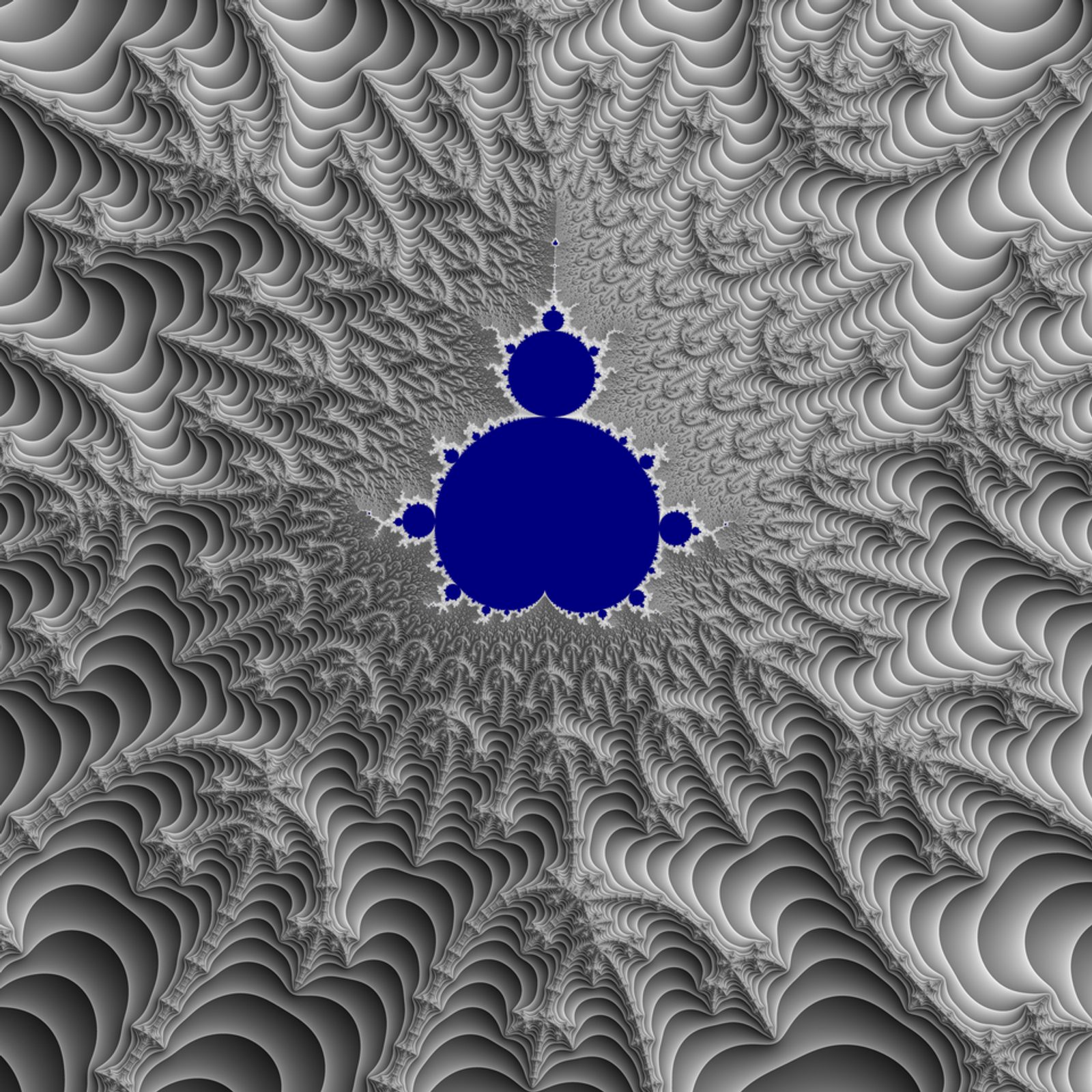
The Mandelbrot set has an inside and an outside. The inside is stable, points that keep returning. The outside escapes to infinity. The boundary between them is infinitely complex, self-similar at every scale, and inexhaustible. That boundary is where everything interesting happens. Including you.
Depth
The bulbs of The Mandelbrot[mandelbrot] set appear at positions governed by the Farey sequence [farey][stern-brocot] and Stern-Brocot tree, the same mathematics that governs musical consonance. The 1/2 bulb corresponds to the octave. The 1/3 bulb to the fifth. Stability under iteration justifies music, and justifies Pythagoras’s[pythagoras] ancient observation that the consonant intervals correspond to simple ratios. Each bulb sprouts branching structures whose branching number equals the bulb’s period, the complexity of the resonance determines the complexity of the choices that emerge from it. Those branches are bifurcations. Each bifurcation is a world-split in Everett’s[everett] sense. The entire fractal boundary is a map of possibility space, the holographic surface between the stable interior and the infinite branching exterior. Consciousness may be what it feels like to be a point on that boundary.
Script
Zoom into The Mandelbrot boundary. Deeper. Deeper. It never resolves. At every scale the same complexity returns.
A coastline from a plane. Then from space. Then a neuron branching.
The camera asks: is this the same thing? It is.
Images
Mandelbrot boundary zoom sequence Farey sequence diagram Coastline fractal comparison Neuron branching structure