7.4 The Surprising Color Wheel
The visible spectrum is a line, but the mind closes it into a circle by inventing colors, purple, magenta, that correspond to no wavelength, and this closure happens before the brain is even informed, in retinal tissue that is embryologically brain.
The mind closes the line into a circle.
Depth
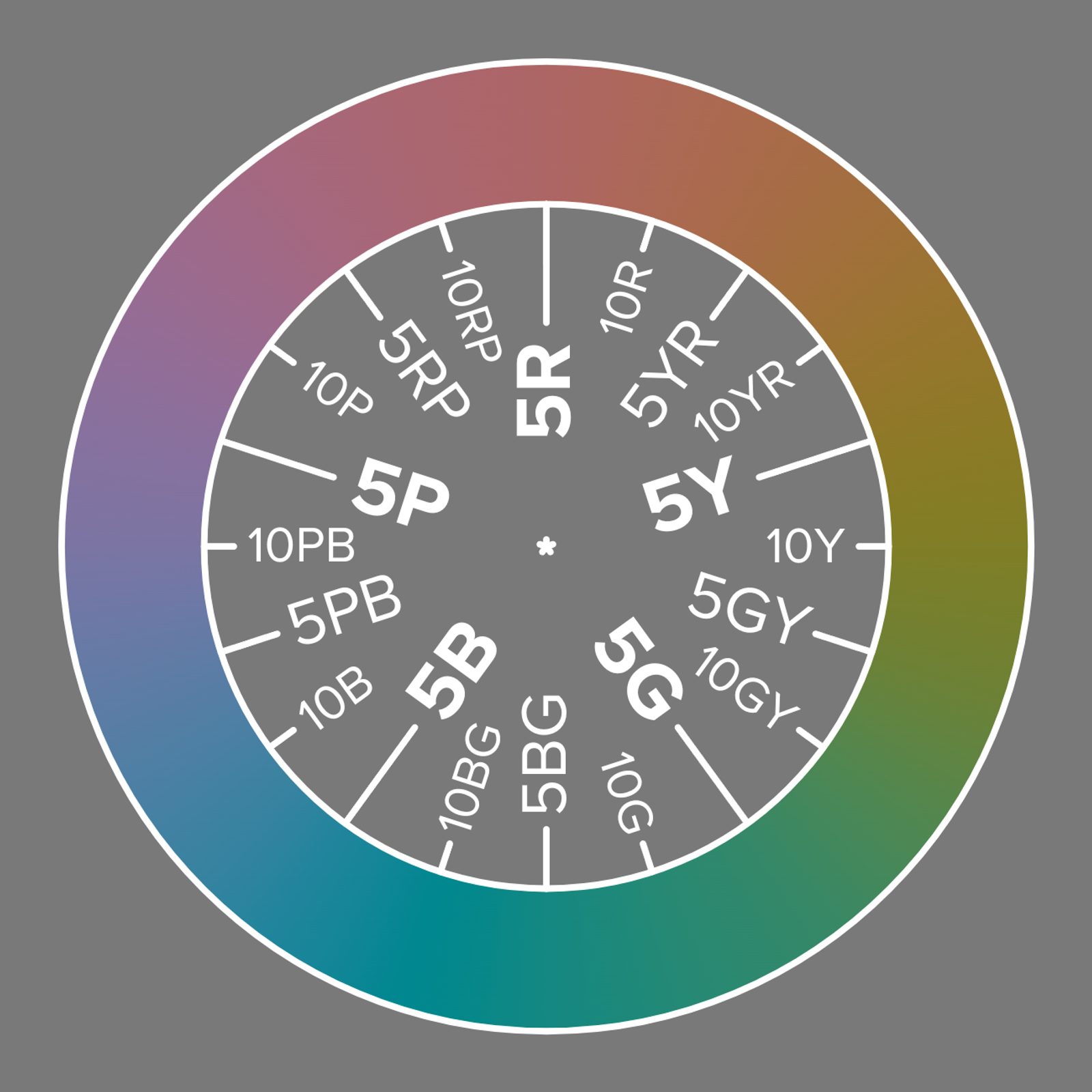
This happens before your brain is ever informed about what you are seeing. At the first layer of your retina, three cone types, roughly tuned to red, green, and blue, receive light. But they do not forward those raw signals. At the very next layer, still within the retina, those three signals are immediately recombined into two opponent channels: red against green, and blue against yellow, a transformation first identified by Ewald Hering[hering] in 1878. By the time visual information reaches the optic nerve, the world has already been transformed. The retina is not a camera. It is a processor. And, here is the surprise, the retina is not separate from the brain. Embryologically it is brain tissue, an outgrowth of the developing brain that migrated into the eye. The thinking started earlier than you thought.
That second retinal layer delivers four perceptual endpoints: red, yellow, green, blue. Not three, four. And not the painter’s red, yellow, blue, nor the physicist’s red, green, blue, but all four, as the natural output of two opponent axes. You can verify this with your own eyes. Try to imagine a color halfway between blue and yellow. You cannot, the visual system forbids it. Now try halfway between red and green. Also forbidden. But blue-green, red-yellow, yellow-green, these exist easily. The axes are mutually exclusive. Their endpoints are the four colors that feel irreducible, that belong to nothing else. This is what the painter was actually reporting. This is also why yellow, which has no dedicated cone, feels as primary as red. It is primary, at the second layer. Yellow is what the retina computes when red and green fire together.
This also dissolves a long-standing argument. Ask a physicist what the primary colors are and they say red, green, blue, the cone layer. Ask a painter and they say red, yellow, blue, closer to the opponent layer, though not quite right. Both are describing real phenomena. The apparent contradiction dissolves once you know which layer you are standing on. At least four distinct levels govern color experience: physics determines how wavelengths of light combine; chemistry determines how pigment molecules absorb and reflect, which is why mixing light and mixing paint follow different rules; the first retinal layer provides the three cone types that sample the result; and the second retinal layer recombines those samples into the opponent channels that deliver perceptual experience. Each level is real. Each is incomplete without the others. [026]
Why these two opponent axes and not others? Here is one compelling idea, though not one we can claim as settled, developed in detail by J.D. Mollon[mollon] among others: the red-green axis may record one of the longest conversations in the history of life, plants developing color to attract animals, animals refining the axis to read it, each driving the other forward. Flowers and fruit did not merely happen to be red and yellow. They evolved to be seen. And the eye evolved to see them. You are the growing tip of that conversation. The blue-yellow axis may solve a different problem: factoring out the color of the light source so that surfaces appear constant across changing light conditions. You see a red apple as red in sunlight and in shadow. This is called color constancy, and it may be what the blue-yellow channel is largely for, discounting the sky so the world stays legible beneath it.
This hypothesis gains weight from an unexpected direction. When deep neural networks are trained on natural images with no instruction about color, their first-layer filters spontaneously develop the same opponent channels. Gradient descent, running for hours, found what hundreds of millions of years of co-evolution may have found before it, because both were responding to the same underlying pressure: the statistical structure of a world lit by a single sun, edged by objects, divided between vegetation and sky. The solution is not arbitrary. It is what close attention to this particular world eventually produces.
What we experience as color, the redness of red, the completeness of a saturated hue, the restlessness of a muddied one, is the shape of that solution, felt from the inside. Why it feels like anything at all is a different question, and a deeper one. [042]