6.4 Two Things Can Be True at Once
When two claims seem contradictory and both are well-grounded, the contradiction usually lives not in reality but in a framework too small to hold both, and the resolution is not to pick a side but to find the larger frame where both become aspects of the same truth.
Contradiction is often the sign of a framework too small for the reality it’s trying to hold.
Surface
Two friends are arguing. Not about facts, they agree on what happened. But they’ve reached opposite conclusions, and each one’s logic is airtight. The conversation keeps circling. Neither is stupid. Neither is lying. So what’s going on?
Here’s one possibility: they’re both right.
Not in a soft, “everyone’s entitled to their opinion” way. Actually right. Each is seeing something real that the other’s framing makes invisible. The contradiction exists not in reality but in the frameworks they’re using to interpret it.
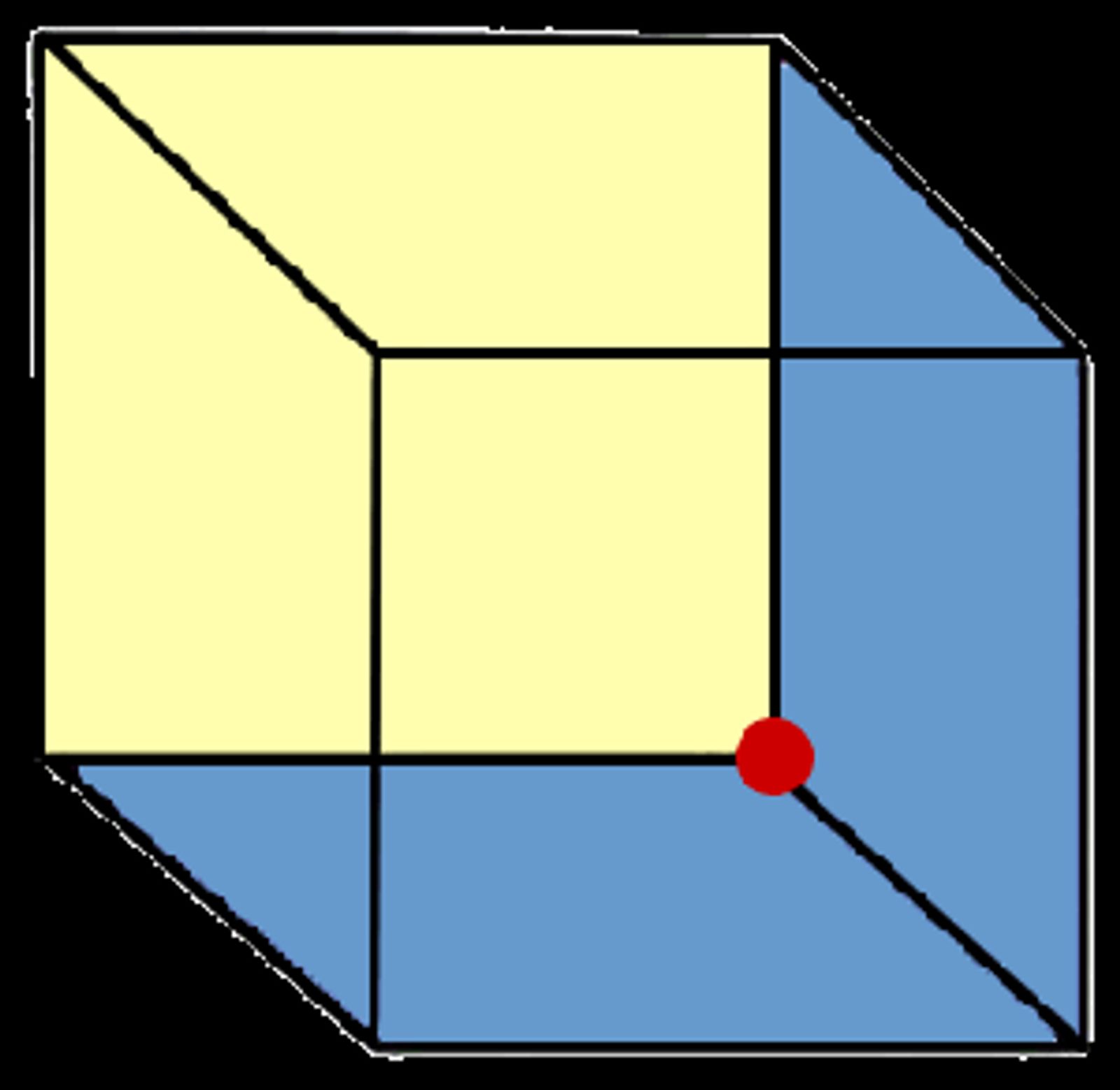
You know those line drawings that flip between two orientations, the Necker cube? You can see it as facing one direction, then suddenly it flips and faces the other. You can’t see both at once. But both orientations are genuinely there in the drawing. The limitation is in the seeing, not in the cube.
Our minds hate contradiction. When two claims seem incompatible, we feel pressure to pick one. Debate culture reinforces this, someone has to win, someone has to lose. But what if the disagreement itself is information? What if it’s pointing at the edges of a framework too small for the reality it’s trying to hold?
Consider love.
You’re overwhelmed by feeling for someone. Your friend, trying to be helpful, or maybe trying to be clever, says: “That’s just oxytocin. It’s just your brain doing what brains do.”
And for a moment it sounds like an explanation. But notice what happened. Two claims are now in apparent conflict: “This is a brain chemical” and “This is love.” The word “just” made them feel mutually exclusive. Either it’s chemistry, or it’s meaningful, pick one.
But why can’t both be true? The oxytocin is real. The love is real. They’re not competing descriptions, they’re descriptions at different levels, of the same phenomenon. The contradiction exists only if you assume one level has to cancel the other out. That assumption is the framework. And the framework is too small.
Physics hit this wall and found a way through.
For decades, physicists argued about whether light was a wave or a particle. Experiments supported both. The contradiction seemed fatal, surely it had to be one or the other. Then came quantum mechanics, and Niels Bohr’s complementarity principle: wave and particle are both necessary descriptions, mutually exclusive in application but jointly exhaustive. Neither alone is complete. The electron isn’t a wave that sometimes acts like a particle, or a particle that sometimes acts like a wave. It’s an excitation of a quantum field, and “wave” and “particle” are two partial views of that deeper reality.
The contradiction was real. The resolution wasn’t to pick a side. It was to find the larger frame where both descriptions became aspects of the same truth.
This move is available more often than we use it.
Next time you’re stuck in a disagreement that keeps circling, where both sides seem reasonable and neither will budge, try asking a different question. Not “which one of us is right?” but “what would have to be true about reality for both of us to be right?”
That’s where the interesting territory is.
Depth
The surface examples, oxytocin and love, wave and particle, illustrate a pattern that runs deeper than those particular cases. Apparent contradictions often signal that we’ve reached the edge of a framework. The pressure to choose sides is the framework trying to preserve itself. The deeper move is to find the larger frame where both claims become aspects of the same truth.
Classical logic says a proposition and its negation cannot both be true: the law of non-contradiction. This is correct within a formal system. But real disagreements are rarely about propositions in that clean sense. They’re about how to frame a situation, which aspects to weight, what counts as relevant context. Two people can agree on every fact and still reach opposite conclusions because their frameworks organize those facts differently.
Niels Bohr’s complementarity principle[bohr] emerged from exactly this situation. Wave and particle descriptions are both necessary for a complete account of quantum phenomena. They’re mutually exclusive in application, you can’t use both simultaneously in the same experimental setup, but jointly exhaustive. Neither alone captures what the electron is. The framework of “it must be one or the other” was the problem, not the electron.
Alfred North Whitehead’s process philosophy offers a different angle on the same insight. For Whitehead, contrast is how experience achieves depth.[whitehead] A flat experience has no tension, no richness. A rich experience holds differences together without collapsing them into sameness or rejecting one side. The universe doesn’t resolve contradictions by eliminating terms, it holds them in creative tension, and that tension is where novelty emerges.
The caloric story from The Map That Was Wrong shows this pattern in the history of science. Heat flows like a fluid, this was the core claim of caloric theory, and it’s actually true. Thermal diffusion is real; heat really does flow from hot to cold in ways that fluid-flow mathematics describes beautifully. Heat is also molecular motion, this is the kinetic theory that replaced caloric. The “contradiction” was between two descriptions of the same phenomenon operating at different levels. The old theory wasn’t wrong about the patterns it described. It was wrong about the underlying mechanism. Both claims were true; the framework that made them seem contradictory was too small.
Kurt Gödel’s incompleteness theorems[godel] provide perhaps the purest example. Gödel constructed a statement that is both true and unprovable within any sufficiently powerful formal system. The system cannot contain both the statement’s truth and its proof. But reality can. The contradiction exists only from inside the system; from outside, there’s no paradox, just a limitation of what the system can see (see Our Intuitions About Large Numbers Are Completely Unreliable and The Arrow Points Somewhere Else).
This matters beyond philosophy of science. Contemporary polarization treats every disagreement as zero-sum: someone must be wrong, someone must win. The frame of “pick a side” is itself the problem. Developing the capacity to hold two truths at once isn’t relativism, both positions have to actually be true, not merely held. It’s a more accurate model of how reality works when it exceeds our frameworks.
The Necker cube keeps flipping because your visual system can only stabilize one interpretation at a time. But someone who has studied the drawing knows both orientations are present, even when they can only see one. That meta-knowledge changes everything. You stop fighting the flip. You start getting curious about what the flip reveals.