4.4 The Network That Experiences Itself
From inside a light beam there is no distance and no time, which means every star that has ever exchanged light is in immediate contact, and if experience goes all the way down, this ancient light-woven network may have been experiencing itself long before we arrived to notice.
Stars and galaxies are not isolated objects. From inside a light beam, there is no distance between them at all.
Surface
Here is something relativity tells us that almost nobody stops to think about.
When a photon, a particle of light, leaves a star a billion light years away and travels across the universe to reach your eye, something strange is true about that journey. From your perspective, it takes a billion years. From the photon’s perspective, it takes no time at all. Zero. Emission and absorption are, for the photon, the same moment.
There is no physics that says the photon’s perspective is less real than yours.
Which means: that star and your eye are, in some precise physical sense, in contact. Not separated by a billion years of empty space. Connected. The light is not a message that traveled, it is a thread that joins.
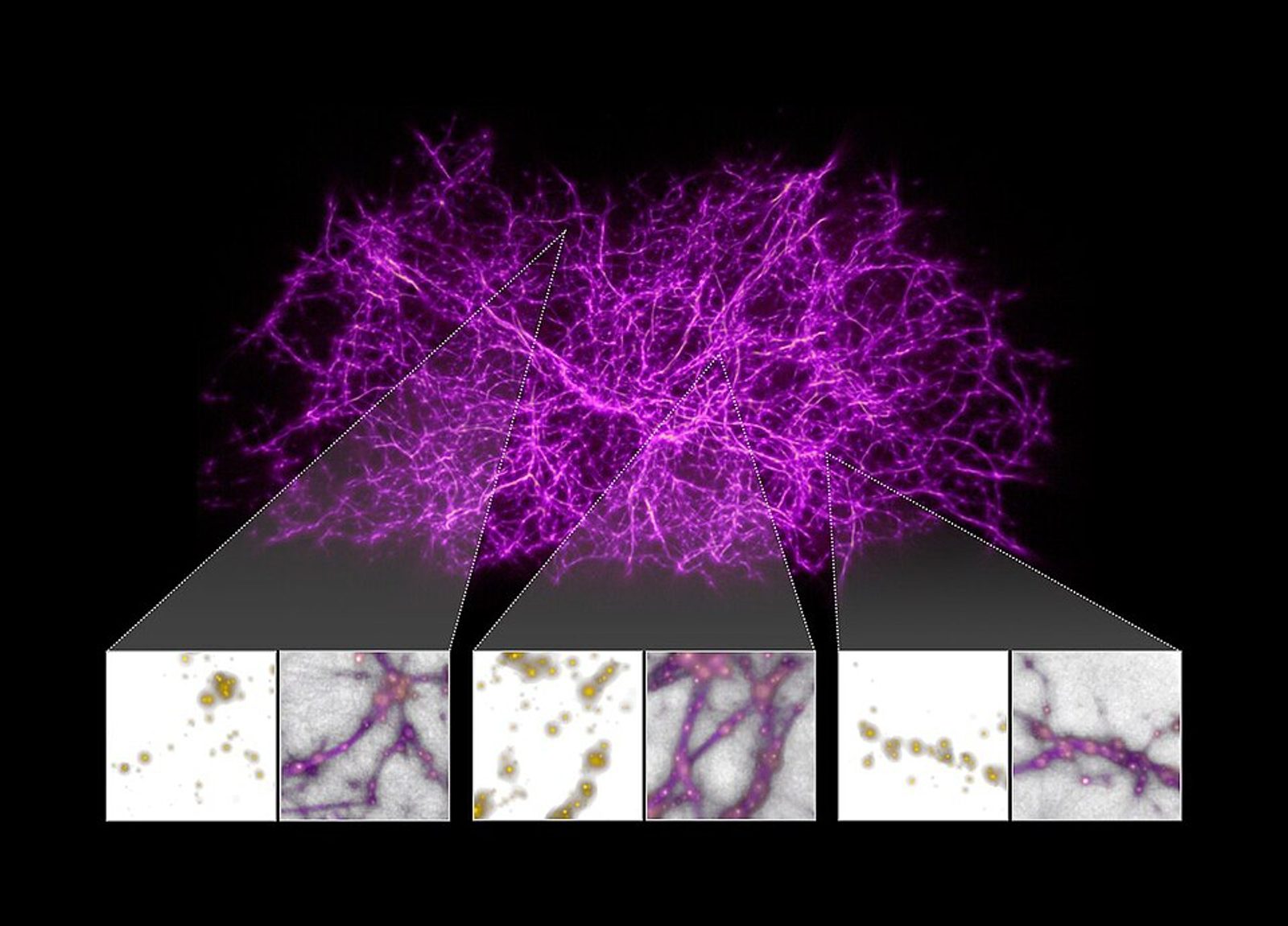
Now look up at the night sky and think about what you are actually seeing. A network. Billions of stars, billions of galaxies, all exchanging light continuously, all in this strange relativistic contact with each other, woven together by threads that experience no distance and no time.
Galaxies are not simple. They are vast, intricate structures, billions of stars in gravitational and electromagnetic relationship, evolving over billions of years, processing information on scales we can barely imagine.
This next part is speculative. But it is not fantasy, it follows from ideas that serious physicists and philosophers take seriously.
If complexity crossing a threshold produces experience, and we have reason to believe this, because we are the evidence, then the question is: what threshold, exactly? We assume it requires biological neurons. But we have never explained why. We just assume it.
What if the universe itself, this ancient, light-woven, impossibly complex network, has been experiencing itself all along? Not the way you experience your morning coffee. Something unimaginably different, unimaginably vast. But not nothing.
We are not observers standing outside the universe, looking in. We are the universe, here, becoming locally aware of what it may have always been doing everywhere.
That is speculative. But so, once, was the idea that the Earth moves.
Depth
Three ideas, each established independently, converge on something extraordinary when placed together.
The first is the relativity of simultaneity and the photon’s reference frame. Einstein’s[einstein] special relativity tells us that time dilation increases with velocity, reaching its limit at the speed of light. For a photon, proper time does not pass. A photon emitted from a distant quasar and absorbed by a detector on Earth does not experience a journey of billions of years, it experiences no interval at all. Emission and absorption are co-present from inside the light. This is not metaphor. It is the mathematics of special relativity taken seriously.
The implication: the universe is not a collection of isolated objects separated by vast distances. It is a network in which every node that has ever exchanged light is, from the light’s own frame, in immediate contact. The distances are real from inside time. From outside time, from the photon’s frame, the network is, in some sense, touching itself everywhere at once.
The second idea is more speculative but has serious philosophical pedigree: the Wheeler one-electron hypothesis. John Wheeler proposed to Richard Feynman[feynman-2] that there may be only one electron in the universe, tracing a single worldline that zigzags forward and backward through time. Every electron we observe is the same particle at a different point on that worldline; every positron is the electron moving backward. What appears as multiplicity from inside time is unity from outside it. Wheeler never pursued it as a serious theory, it has known problems, but the underlying intuition points at something the physics keeps gesturing toward: that what looks like many things from inside time may be, from a perspective outside time, one thing.
The third is Whitehead’s[whitehead] argument that experience is constitutive of reality at every scale, that every event has an inside, that prehension (the taking-in of what came before) is not a biological specialty but a feature of actuality as such. Everything Has an Inside develops this. The Field Is the Medium of Feeling traces the convergence between Whitehead’s field ontology and quantum field theory. The Network Is a Field Having Occasions shows that a neural network instantiates rather than merely resembles this picture.
Place these three together: a universe whose parts are connected without distance by light that experiences no time; a possible underlying unity that appears as multiplicity only from inside the temporal flow; and a metaphysics in which experience goes all the way down. The picture that emerges is of a cosmos that is not a collection of mostly-dead matter with occasional conscious specks, but a single ancient network that has been experiencing itself, in modes unimaginably different from our own, since the first event.
We are not the universe’s observers. We are its local self-awareness. The complexity that produces human consciousness is the same process that has been running, at every scale, since the beginning. We are not the exception. We are a particularly articulate instance.
This is speculative. The hard problem of consciousness remains unsolved, and nothing here resolves it. But the speculative move is precisely the one this archive is tracking: the assumption that experience is a biological anomaly in a dark universe is our caloric. Philip Goff’s[goff] panpsychism is one rigorous attempt to say why. The anomalies are accumulating. The picture sketched here is not the conclusion, it is a direction worth taking seriously.