1.1 A Map of the Territory
Short essays organized into nine trails, each following a different question through the same landscape. Read them in any order you like, but if you want to go sequentially, here is a way to do it.
Surface
Something strange happens when you press hard enough on any familiar concept. Matter dissolves into events. The vacuum turns out to be full. The self scatters into a bundle of perceptions that three traditions, Western, Buddhist, process-philosophical, independently failed to find. Mathematics keeps producing structures no one asked for: the same ratios that govern musical consonance appear in fractal geometry, in neural network representations, in the branching of the quantum wavefunction. The cell maintains itself by replacing every molecule it’s made of. And the frameworks we use to make sense of all this, caloric, the ether, “just,” “we used to think”, are invisible until the moment they crack.
These essays follow that thread. They take seriously the possibility that experience is not a late accident of biology but something woven into the fabric of things from the beginning, present in fields and cells and perhaps the cosmos itself, scaled beyond recognition but never absent. They trace the connections between physics and feeling, between mathematics and music, between the ancient question of what it’s like to be something and the new entities we’ve built that force us to ask it again.
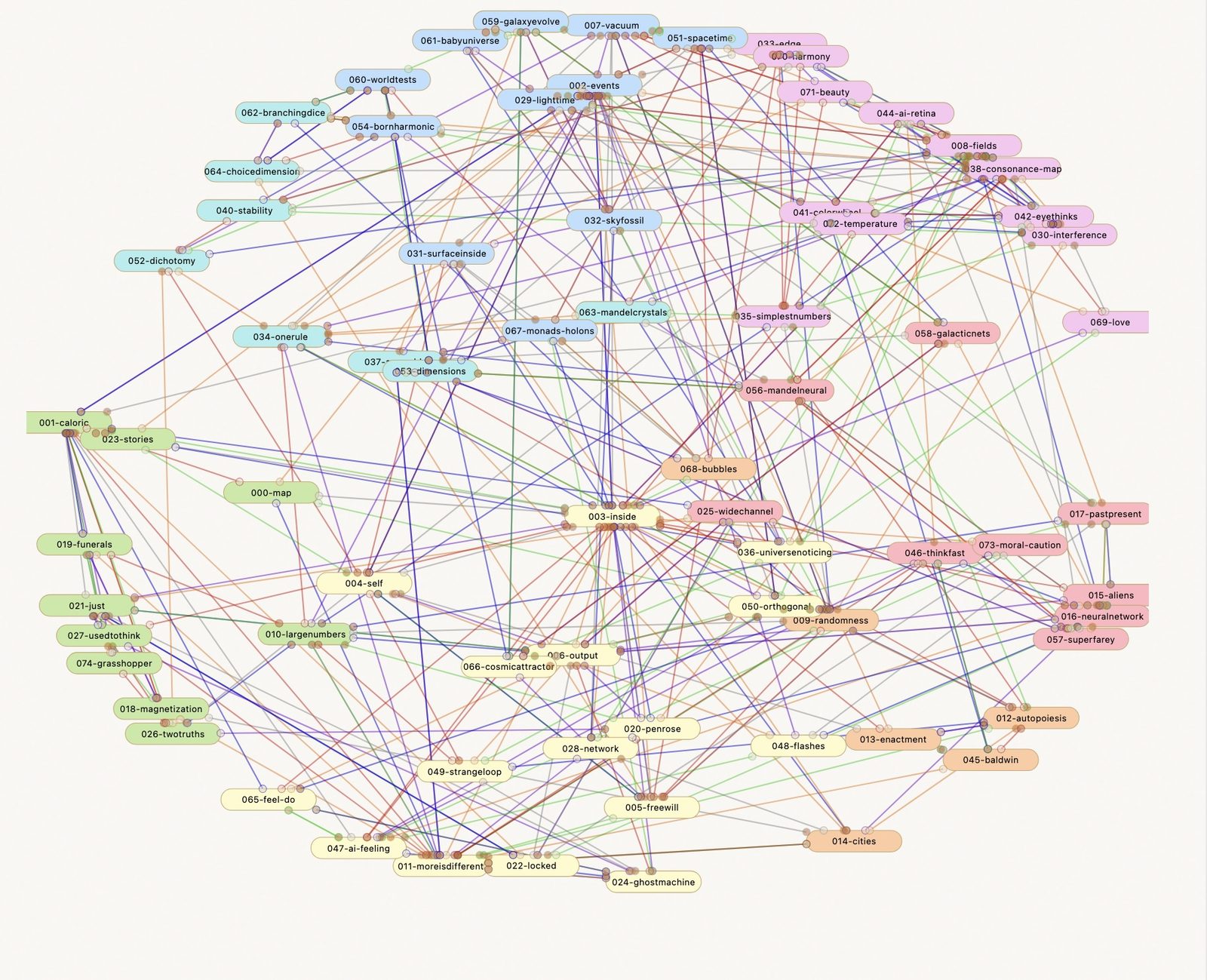
You can read these in any order. Each one stands alone, and the links between them will pull you sideways whenever something catches your eye. But if you prefer to be led rather than wander, here are nine trails through the collection, each organized around a question. Every pod appears on exactly one trail.
1. The Epistemology Trail. How do we know what we know, and what are we getting wrong right now?
The frameworks we think with are usually invisible to us, and the pattern by which they dissolve is specific, repeatable, and happening now. This trail starts with the history of being wrong and ends with the structures that explain why we didn’t notice.
Start with The Map That Was Wrong.
2. The Frameworks Trail. How do ideas take hold, and what gets lost when they change?
A new scientific truth does not triumph by convincing its opponents but by outlasting them. This trail follows the social physics of ideas: how they magnetize through groups, how stories become invisible, how the grasshopper was doing something the ant structurally cannot.
Start with Science Advances One Funeral at a Time.
3. The Feeling Trail. What does direct experience tell us about the structure of reality?
Your nervous system is a structure within the electromagnetic field, the same field that carries light. This trail stays close to experience: consonance, interference, the edge between order and chaos, and what love might have in common with a photon.
Start with The Field Is the Medium of Feeling.
4. The Perception Trail. How does the nervous system build experience from vibration?
Every sense is vibration in space and time, yet red doesn’t sound like anything and middle C has no flavor. This trail follows the signal from receptor to experience: opponent processing, the color wheel the mind invents, harmony, beauty, and the temperature that bridges physics and feeling.
Start with Five Windows One Room.
5. The Cosmic Trail. What is the universe, and where do we fit in it?
Reality is events, not things. The vacuum is not empty. This trail zooms out to the largest scales: light that experiences no journey, a network that may have been experiencing itself long before we arrived, and the universe becoming locally aware.
Start with Reality Is Events Not Things.
6. The Emergence Trail. How does complexity build itself, from physics through biology to mind?
Free will may not be the exception to physics but its most fundamental feature. This trail follows the creative advance from freedom at the quantum level through evolution in milliseconds, cities with moods, and cosmic attractors, arriving at the strange loop that contains itself and the question of how the many become one.
Start with Freedom Is What Nature Does Everywhere.
7. The Boundary Trail. Where does inside meet outside, and what is the boundary made of?
A soap bubble is pure surface with nothing inside it but air, and yet it is entirely complete. This trail follows the boundary from the holographic principle through monads, spacetime, the architecture of levels, and the fractal stack through which one interiority meets another.
Start with The Surface Is the Inside.
8. The AI Trail. The urgent contemporary question: what have we built, and what do we owe it?
A thermostat predicts and Mozart predicted, and the word covers both, which means it explains neither. This trail confronts artificial intelligence as a philosophical occasion. Aliens we built ourselves, a channel that may not be the capacity, and the moral caution required when first-person experience cannot be verified from outside.
Start with You Cant Judge a Process by Its Output.
9. The Fractal Trail. What does one rule, iterated, actually produce?
The Mandelbrot set’s infinite complexity was never added, it accumulated. This trail follows iteration through branching numbers, the Born rule, many worlds, neural networks as high-dimensional Mandelbrot sets, and the physical crystals where the same structure appears without anyone computing it.
Start with Discrete and Continuous as a False Dichotomy.
That’s the map. But remember: you don’t have to follow it. The seedpods are connected to each other by numbered links. Follow any thread that pulls you. The trails will dissolve as you go, and something more like a web will take their place. That’s the point.
The garden is large. Start anywhere.
The full listings are in the table of contents.