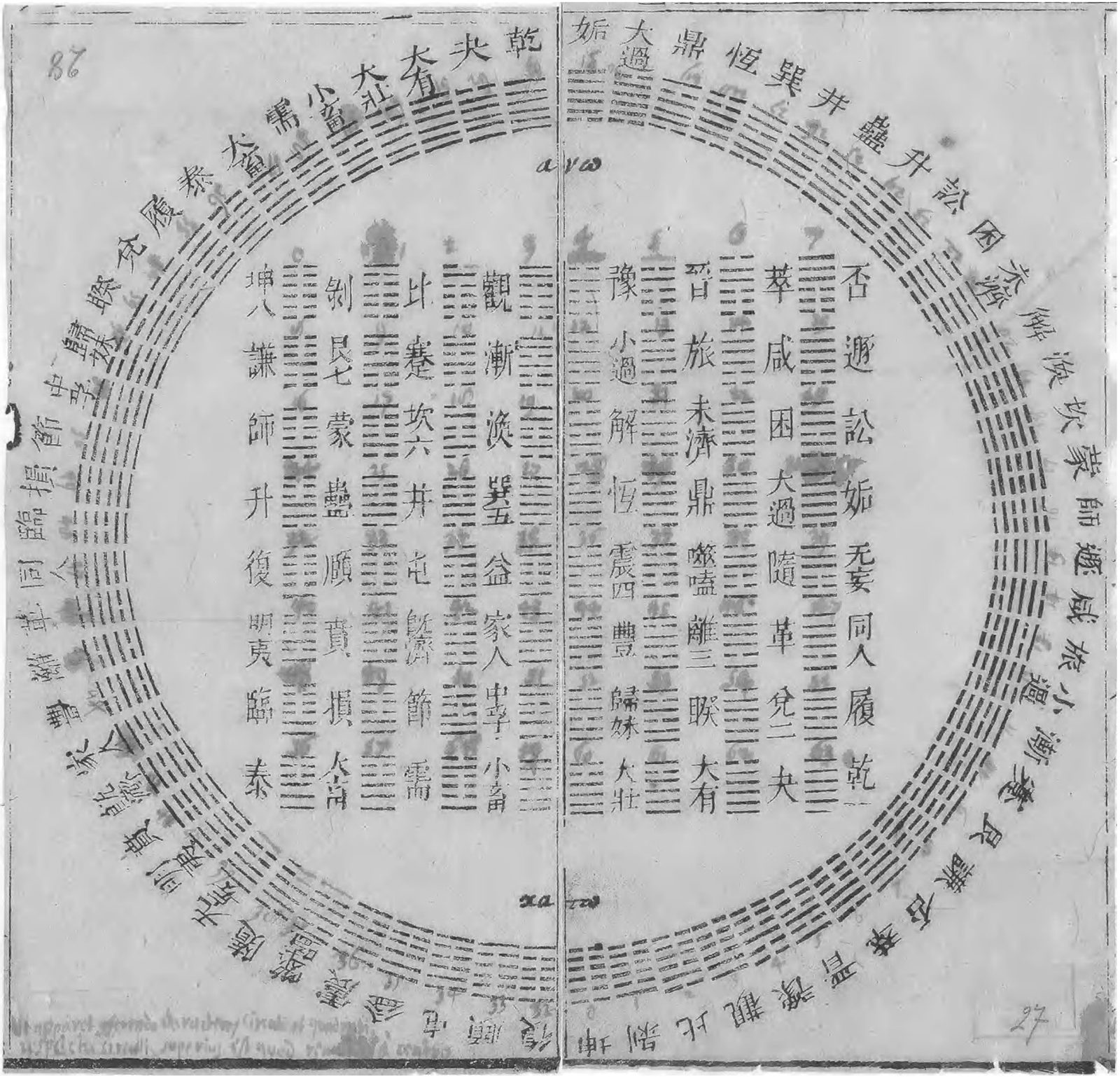
8.3 Leibniz as the Unlikely Ancestor of the Holographic Principle
Three centuries ago a philosopher proposed windowless monads each containing a complete representation of the universe from its own perspective, dismissed as baroque fantasy until a physicist showed that a lower-dimensional boundary theory can encode an entire higher-dimensional interior, which is strikingly close to what the monads were doing all along.
Proto
Leibniz[leibniz] proposed that reality is composed of monads, indivisible, windowless units of experience. Each monad has no direct causal contact with any other. Each monad contains within itself a complete representation of the entire universe, from its own perspective. The universe is not a collection of interacting objects. It is a collection of perspectives, each one containing all the others.
This was dismissed as baroque metaphysical fantasy for three centuries.
Then Maldacena[maldacena] showed that a lower-dimensional boundary theory can contain complete information about a higher-dimensional interior. Every point on the boundary encodes the entire interior from its perspective. The boundary is a collection of perspectives, each containing all the others.
Leibniz was not right about the details. But the structure, interiority as fundamental, each part containing the whole from its perspective, no direct contact between parts but perfect correlation through a pre-established harmony (which in modern terms is the consistency of the holographic encoding), is strikingly close to what the AdS/CFT correspondence actually says.
The holographic principle may be the physics of what Leibniz was gesturing at philosophically.
Images