9.8 The Virtual Dimensions Formula as a Publishable Conjecture
Replace the arbitrary tolerance in high-dimensional near-orthogonality with a principled one drawn from the Farey sequence, and a formula emerges, V(d,n) ~ (n²/π²)^d, that connects musical consonance, neural network superposition capacity, and quantum branching under one expression.
Proto
If you have a space with d actual dimensions, how many nearly-orthogonal directions can you fit in it? The answer matters because nearly-orthogonal directions can carry independent information without crosstalk, like independent channels.
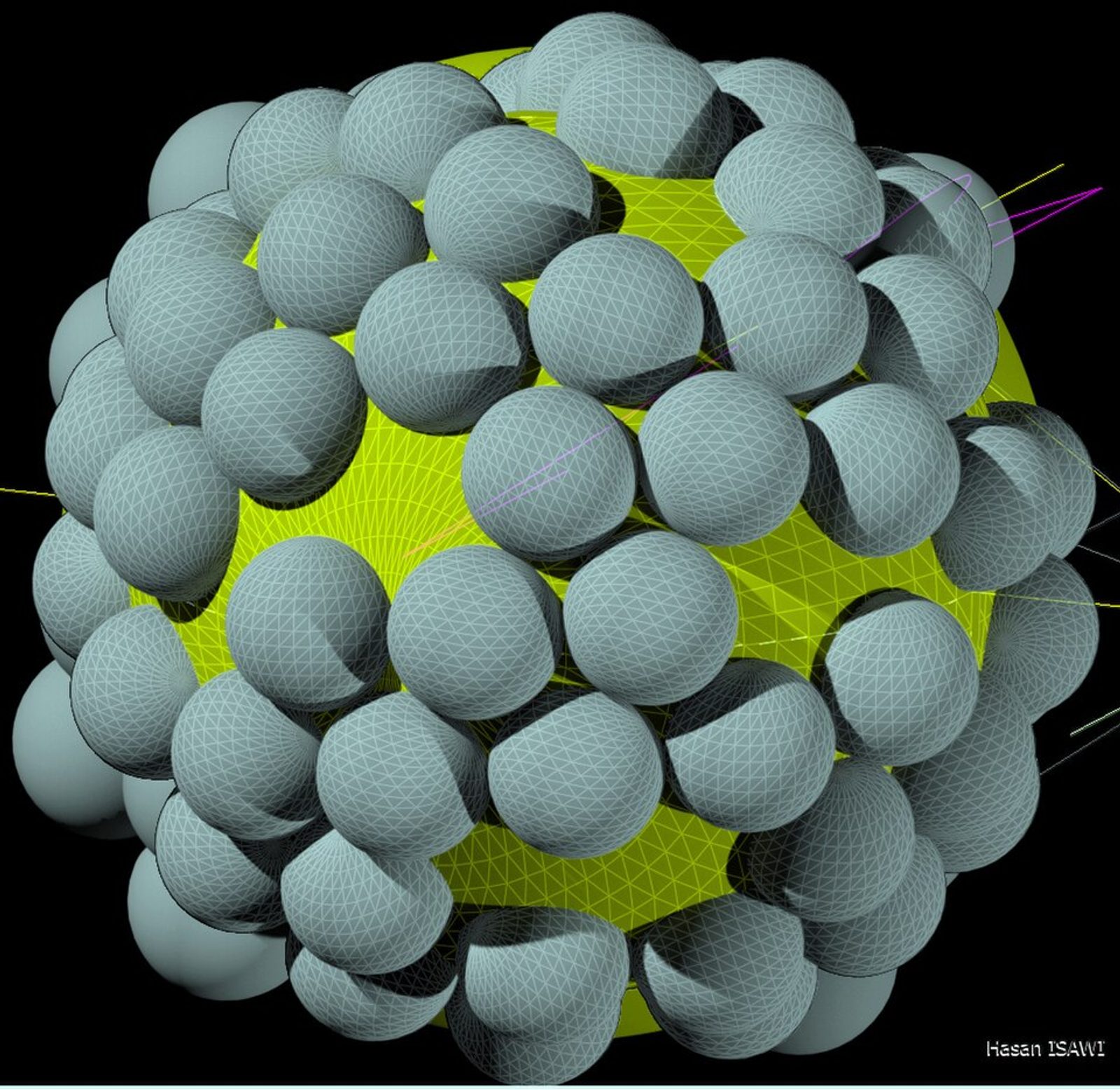
Standard mathematics (Johnson-Lindenstrauss[johnson]) already shows the answer is exponential in d. But the threshold for “nearly orthogonal” is arbitrary, you pick a tolerance ε and proceed.
The conjecture: replace the arbitrary tolerance with a principled one drawn from the Farey sequence. The Farey sequence orders all rational numbers between 0 and 1 by complexity, simplest fractions first. It provides a natural hierarchy of distinguishability, exactly as the ear uses it to decide which musical intervals are consonant. The octave (1/2) and fifth (1/3) are shallow in the tree. Dissonant intervals are deep.
The resulting formula:
V(d, n) ~ (n²/π²)^d
Where d is actual dimensions, n is Farey depth (your consonance threshold), and n²/π² is the count of Farey fractions at depth n, with π entering naturally from the circular structure of the rationals, not by assumption.
Applications: neural network superposition capacity, Many Worlds branch distinguishability, and potentially the information capacity of physical space itself. The formula connects musical consonance, high-dimensional geometry, and quantum branching under one expression. That connection has not been made explicitly in the literature.