3.4 The Simplest Numbers Come First
The universe counts simply first, the Farey sequence orders fractions by complexity, Benford’s law finds the same hierarchy in empirical data, and every culture that ever made music independently discovered the simplest ratios before anything else.
Farey, Benford, and the Shape of Infinity
Surface
Depth
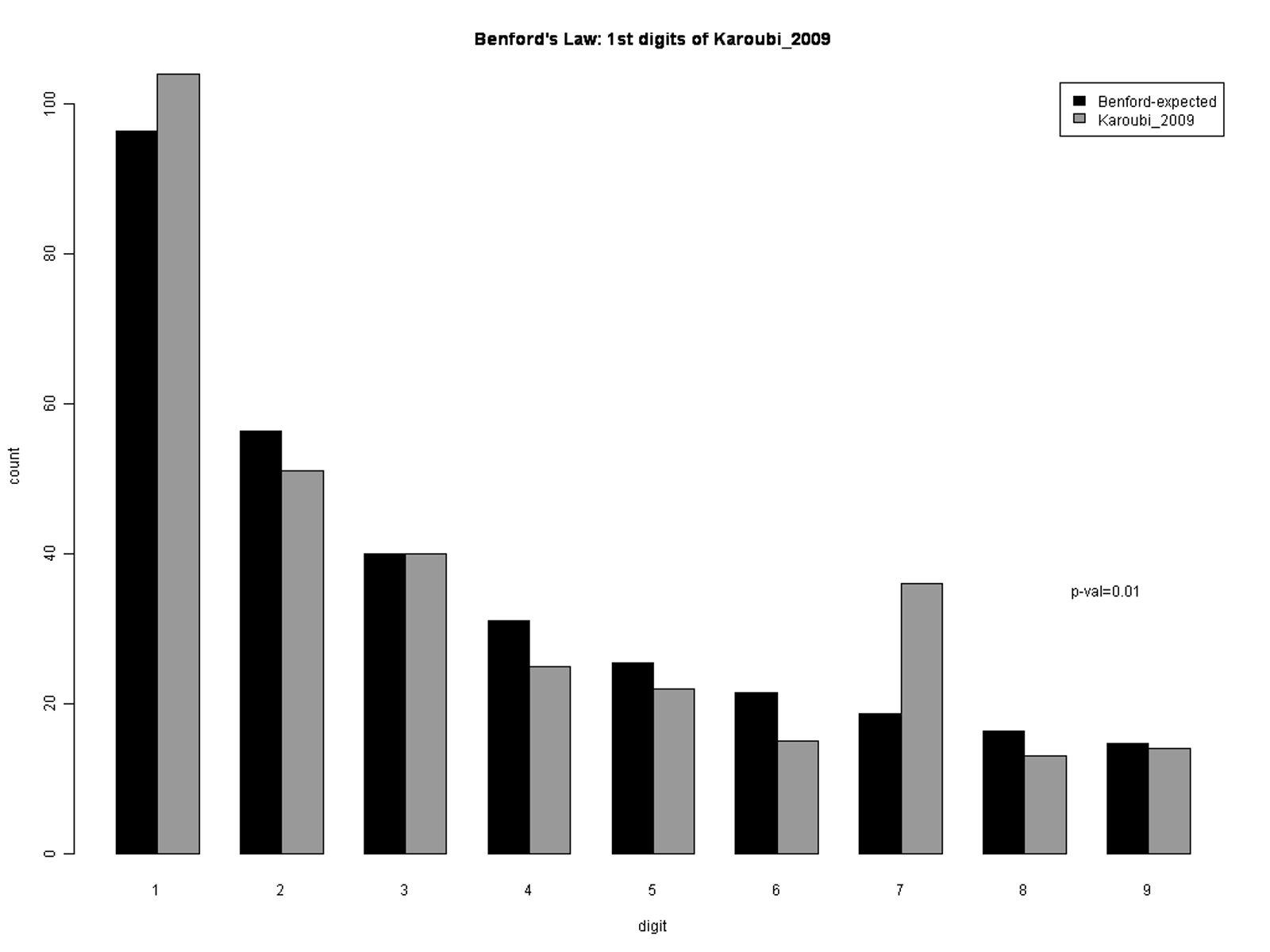
The Farey sequence[farey] counts all rational numbers between 0 and 1 in order of complexity, simplest fractions first, infinity packed into a bounded interval with a natural hierarchy. The most consonant musical intervals, the octave, the fifth, the fourth, are simply the simplest Farey fractions. Every culture that ever made music independently found them first. Meanwhile Benford's law[benford], first noticed by Simon Newcomb[newcomb] in 1881, finds the same hierarchy in random collections of real world numbers, accounting figures, physical constants, census data. Numbers beginning with 1 appear 30% of the time. Numbers beginning with 9 less than 5%. The distribution is logarithmic, the same logarithm that compresses infinite complexity into bounded space. Benford is the empirical shadow of what Farey makes precise. The universe counts simply first. Complexity accumulates later. This isn’t a coincidence of mathematics, it’s the signature of a world built by iteration from a single rule. The formula for virtual dimensions arising from actual ones, V(d,n) ~ (n²/π²)^d, carries this signature explicitly: π from the circular structure of consonance, the logarithm from the compression of the tree.
Script
A musician tuning by ear. She finds the octave immediately. Then the fifth. Then the fourth. She’s not calculating. She’s finding the simplest numbers first.
An accountant’s fraud detection software flagging a ledger where too many entries start with 7. The same hierarchy. Different domain.
The Farey sequence written out: 0/1, 1/2, 1/3, 2/3, 1/4… Infinity, tamed.
Images
Farey sequence visualization Benford’s Law distribution graph Stern-Brocot tree diagram Musical interval ratios on a number line